
Dual BA Student Maya Koka ‘26GS Named a Gates Cambridge Scholar
Koka joins an elite cohort of future leaders ready to pursue fully-funded graduate studies at one of the world’s top universities.
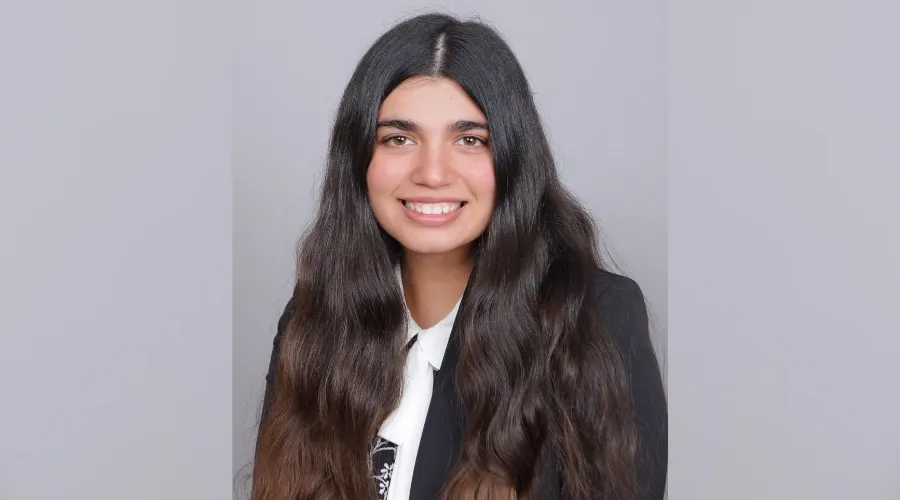
Maya Koka ‘26GS joins a cohort of 76 Gates Cambridge Scholars from around the world, selected for their academic intellect and social leadership. Koka is one of four Columbians awarded the prestigious scholarship, which grants each scholar fully-funded graduate study and research in any subject at the world-renowned University of Cambridge. The program’s goals are to create a global network of future leaders who are committed to changing the world—and Koka embodies just that!
A philosophy student in the Dual BA Program between Trinity College Dublin and Columbia University, Koka’s studies focus on language philosophy in domestic abuse testimonies, with the broader goal of advancing survivor-centered legal interventions. At the University of Cambridge, she plans to continue the research she started at Columbia while pursuing a one-year Master of Philosophy degree.
Koka shares her insights into her philosophical research, what her studies mean to her, and all she hopes to continue developing while at Cambridge.
Tell us about your academic/philosophical pursuits at Columbia:
I study philosophy with a focus on metaethics, ordinary language philosophy, and the philosophy of law. My senior thesis examines a distinctive failure of linguistic agency that emerges from the social conditions under which domestic abuse survivors report violence. Supervised by Professor Karen Lewis, my research focuses on cases in which a survivor produces an utterance that appears to satisfy every familiar criterion for a report of harm: it describes abuse, identifies an assailant, and is issued with the intention that it be taken as such. I examine how semantic disablement and testimonial smothering emerge when the conditions needed for testimony to “count” are absent. My work reframes these failures of recognition as structural conditions that preempt survivors’ speech from altering the moral landscape (even when grammatically complete). Inspired by Thomas Paine’s conviction that ideas must serve the public good, I seek to bridge rigorous philosophical analysis with meaningful change in the lives of survivors.
"There is a kind of constant hypervigilance, a careful calculus of survival, that informs when to speak, how to speak, and whether it is safe to be heard at all. What philosophy has given me is a way to understand those moments and their stakes."
What do you plan to pursue at the University of Cambridge and how will the scholarship help you achieve your goals?
At Cambridge, I will pursue the M.Phil in Philosophy as the first stage of a longer research trajectory culminating in doctoral study. My specific focus is on testimony that depends on a shared set of social and institutional practices that recognize and ratify speech acts as victim resistance. By building on debates in contemporary metaethics and ordinary language philosophy, my research seeks to clarify how speech fails to bring about action, why certain speakers are unable to do things with their words, and what forms of communicative repair might return power to speech that has been stripped of its authority.
What was the application process like and how did you manage that alongside your studies and extracurriculars?
After receiving departmental nomination from the Philosophy Department at Cambridge, I was invited to interview and assessed across four criteria guidelines: academic excellence, research fit with Cambridge, a demonstrated capacity for leadership, and a sustained commitment to improving the lives of others. What stood out to me most during this stage was the sense that I was being asked to bring my full intellectual and personal trajectory into the room. I found myself reflecting on how my experiences—both academic and personal—inform the questions I have around the relationship between language and action. In speaking about my proposed research, I was able to articulate how my interest in linguistic agency emerged not only from formal philosophical study at Trinity and Columbia, but from years spent listening to and working alongside women whose stories have the power to change the world. So often, when I sit with survivors, I catch glimpses of myself and of people I love in the patterns of fear, calculation, and resilience that shape their lives. There is a kind of constant hypervigilance, a careful calculus of survival, that informs when to speak, how to speak, and whether it is safe to be heard at all. What philosophy has given me is a way to understand those moments and their stakes. My research asks what happens when someone does everything right linguistically, and yet their words fail to move others to recognition or action. Being able to intellectualize these experiences allows me to capture them by locating the source of victim resistance in how an audience registers survivor testimony. The interview felt like an opportunity to show how the analytical nature of my work grows directly out of what I have witnessed. That perspective is what I hope to continue developing at Cambridge, bringing philosophical precision to experiences that are often felt intensely but rarely named with conceptual clarity.